Feeds:
Posts
Comments

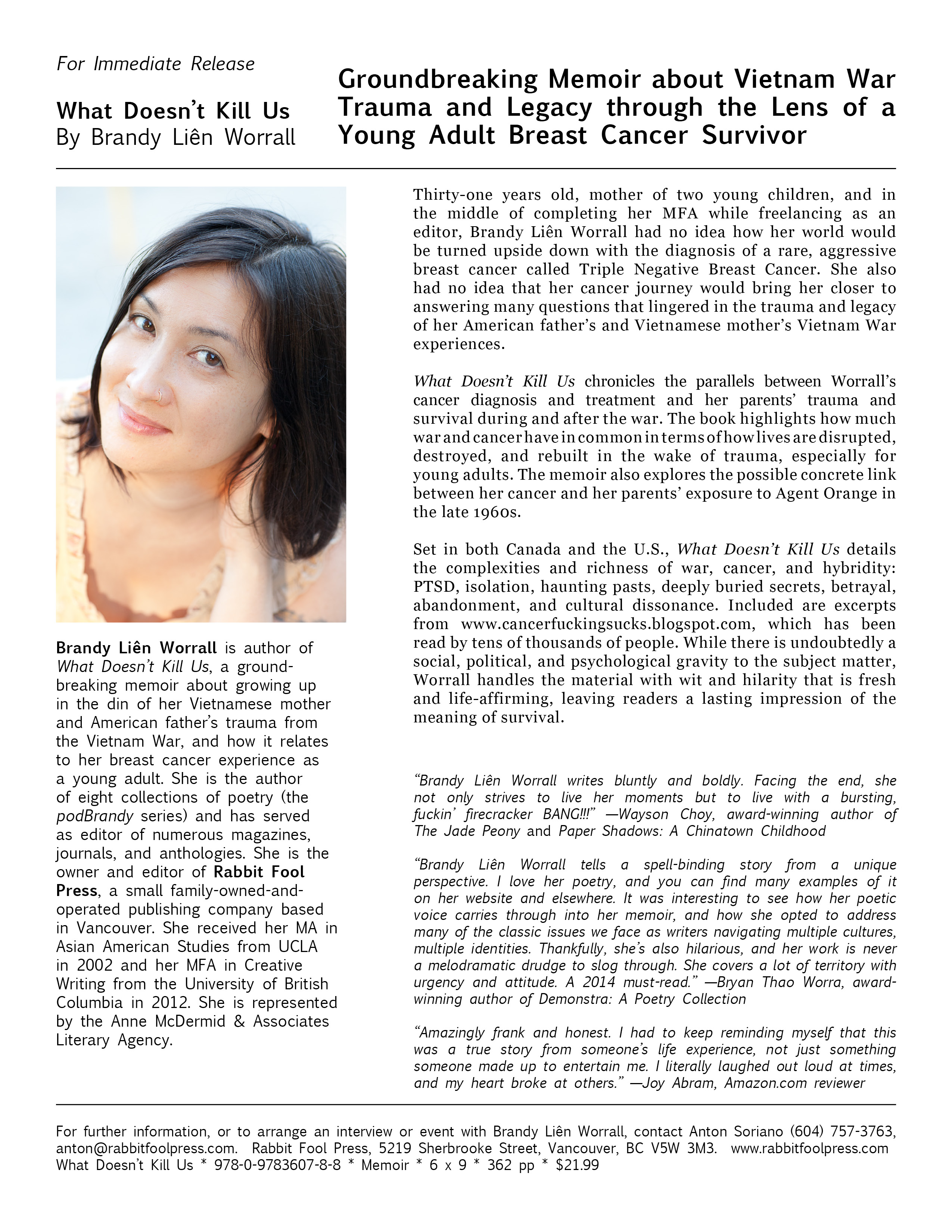
Mark your calendars, Vancouverites and visitors to our wonderful city! Thursday, January 15, 2015 will be a night to remember, as I read from What Doesn’t Kill Us, as well as share new work from 17 Days, my work-in-progress that’s the sequel to WDKU. In addition, jazz musician Laurel Murphy will be joining me and performing songs from her just-released and much-anticipated CD, When I Was a Bird. A portion of the sales from the my book and Laurel’s CD will be donated to Callanish Society, a small non-profit organization that serves individuals and families dealing with cancer. Please join us for this special event, bring your family and friends, and spread the word! Happy Holidays!

WDKU-Heartwood

WDKUpr

Kitteh Endorsement

IMG_1508.JPG

Voices

One of the critiques that I got about the book–one that I’d been expecting–was how I portray my mother’s voice. Her broken, heavily accented English. Would people think I’m mocking her, making fun of her? Then I thought about how I also portray my father’s voice–his slow, grammatically incorrect yet vernacularly appropriate twang. Let’s make this quite clear: these are the voices I’ve heard growing up and still hear in my head. They ARE my parents’ voices. And they are colourful, wonderful, unique–they are their own. And to portray them otherwise would be to erase those voices and all the quirks and highs and lows that come with them.

Several people suggested that it would be so wonderful and fun to do an audiobook version of What Doesn’t Kill Us. When I thought of the possibility, I became filled with glee.

When my father passed away almost nine months ago, I would call my parents’ house in the hopes of no one being home, so that I could hear my father’s voice on the answering machine. That simple message, “You reached the Worralls at 436-xxxx…,” wrapped around me like a thick blanket, warm and fresh from the dryer. I guess this is what I’m saying: when you’re writing stories about people you love, pay very close attention to the voices in your head, and in your heart.

This.

#TBT: Glamour Gal

I don’t normally do #TBT, but I figured that since I’ve gotten so much awesome feedback and reviews for my memoir, I’d give the readers a treat…the video that is mentioned in the book. And if you haven’t read the book yet, here is one of the highlights. Enjoy!

Lotsa Brandy For Sale

IMG_1421.JPG

Buy these pieces of my brain.

It’s my birthday! Happy 39th to me! One way I’ve decided to celebrate is by making the Kindle version of my book free for a limited time. So tell all your friends, and if you haven’t already gotten a copy, go get yours now before the promotion period ends.

When I started the publishing journey with this book over two years ago, I was so excited to have numerous agents thrilled to represent my work. Even though I had all the skills and networks to have moderate success with publishing my own memoir, I decided to go the traditional route and have it sent out to publishers in the hopes of getting a decent contract. My agent has been incredible in guiding me through this process, and my book has landed in the laps of several reputable editors. However, as much as they loved the book, they could not get it past the true gatekeepers of the publishing industry–the marketing people. I was told that though my voice was fresh and raw and my story was compelling, the market already had too many “cancer memoirs.” My book was boiled down to those two words, and anything else that makes it unique, timely, and nuanced was made invisible, erased. Also, what these responses say to me is that the “cancer memoir” is done and over, nothing more to be said about it, we’ve heard these stories too much already, unless you’re a celebrity–which I find completely ridiculous. So I made the leap and decided to move forward with publishing the book through my publishing company, Rabbit Fool Press.

The one regret that I have with spending time going the traditional publishing route and not trusting my gut initially with self-publishing is that my father passed away before seeing the book in print. He was excited for me to write this and tell our family’s stories, but he died the day my agent told me that the book was ready to be sent out to the publishers. He did manage to read the first few chapters after he was diagnosed–and he laughed appreciatively. That was awesome. I’m glad he was at least able to do that.

So on my birthday, and in honour of my dad who passed away from cancer which was thought to be caused by exposure to Agent Orange, we are making the Kindle version available free for a limited time. If you agree that this story is worth being heard–that other cancer stories are worth being heard–then share this status with everyone you can, download the book, consider buying the paperback, ask your public library to purchase the book, teach the book, and come out to see me when I do a book tour in Spring 2015. This book’s success depends on grassroots efforts of the communities with which I am aligned–communities that I know all care about making silenced and untold stories known and heard.

http://www.amazon.com/What-Doesnt-Kill-Brandy-Worrall-ebook/dp/B00PIWYKCO/ref=tmm_kin_swatch_0?_encoding=UTF8&sr=1-2&qid=1416674638

Vietnam, February 2015

Rickshaws. Rice paddies. An old war. Napalm.
“The Vietnamese people are so nice, so accommodating,”
I’m always told,
White people reassuring me that my Vietnamese half isn’t inherently demonic,
like the American soldiers were told. No—
“They are not people. They are things that you must kill by any means.
They are not human.”
And that was Dad’s first memory of Vietnam.
Me—I don’t have memories yet, but I’m sure glad those people are so nice.

Eagle Brand medicated green oil. Chay-yaw. Buddhas and their altar. My ghost family.
“You’re American like your daddy,” Mom tells me. “Your sister—she Vietnam.”
I can’t prove otherwise,
my tongue and throat conspire against me when I speak Vietnamese as I know how.
But I try to show Mom how much I like durian…
just like White people who’ve been to Vietnam on vacation or for research,
how they say they’re experts in durian and nuoc mam. They tell me this
after they try to make small talk on planes, asking
“Where are you from?”
And I say, “I was born and raised in Pennsylvania, but now I live in Canada.”
And they say, “No, but where are you really from?”

Alcohol. PTSD. Heaven and earth and reincarnation.
Temples 90 minutes away. Church with an outhouse down the road,
by the crick.
I don’t know how it’s going to be when I go.
I’ve gone there in my mind so many goddamn times,
my migraines and insomnia from all that jetlag catching up,
but I know it’s not the same.
I just know there’s a demon I have to face.
I don’t know if it’s me.
I don’t know what it is.

That porch swing, white paint chipping and flaking,
those two rusty chains and the hooks that hold them up,
the chains also hold up 90% certainty that we won’t crash
when we sit down, that we won’t splinter upon impact
on the oil-stained concrete…that swing swung us back and forth,
between the past in the back, almost hitting the cherry Chevy Nova parked
behind it, and the future at the front of our extended legs,
toes en pointe toward the hills basking in the orange ooze
of the sinking sleepy sun.

That porch swing was our time machine.
We got older and younger all at once with each launch.
Sometimes we became timeless,
or forever.
But we knew we’d always have to land at some point,
and get up,
and walk away.

Perfection of everything swung on that swing.
If I wanted to, if I could, I’d unhook the swing,
carry it across lands to find different rusty hooks to attach it to,
and it would be something “different,” as Pappy would say
in his sweet feathery husky twang,
to fly into the past and future in other spots,
but I would never be able to find that hill,
that sunset,
that cherry Chevy Nova and the oil stains the car tattooed
on the porch.
That swing, there, will always hold us up.
We’ll never fall down in time.

Houses, Homes #9: Pipes

His pipe collection. The walnut pipe holder for it.
Little curves to cradle the bowls, the stems held in place
in the two rows of three holes close to the handle. I know I’ll never smell anything
like that again—
the sweet earthiness of tobacco residue, the scorched wood, the plastic tips
where Dad’s lips would hug the stem in a tight embrace,
breathing in moments of calm, solace,
like when I put my face in my baby’s neck and inhale,
just like that.

Second-hand smoke didn’t exist in the 80s,
so I’d breathe along with Dad. He never told me to go away
when he needed to puff, and I’d watch mini plumes billow from the bowl
and out his mouth, a smoke snake trailing up and
disappearing into heaven.

Smoke lay in his beard. His bristly beard
that tickled my cheek. I can remember that tickle
but not the hug that brought me that close to him.

His pipe collection organised to be something that marked his days
from a particular time when tobacco came in a big tin can,
just like coffee. And I’d open the tobacco can just to smell,
like I would with the coffee. But Mom, she didn’t know

what those pipes were meant for
in this moment,
and now they are all lost, lost, lost,
and fallen. Probably broken, cracked, fractured,
buried in the earth somewhere with all the rest.

I wish I could hold a pipe in my palms,
holding the thing where his breath would pass in and out,
his breathing that he never thought anyone would care about,
but I do.